Guides
Appliance Repair Certification by State: Which Board to Apply To
Appliance repair certification by state: the board to apply to in California, Texas, Louisiana, Virginia and Michigan, what the file holds, how long it takes.
What to take away
- Five states run active programs for appliance repairCalifornia, Texas, Louisiana, Virginia and Michigan. Each one asks for something different.
- California splits the work between a repair dealer registration and a refrigeration contractor license. Texas licenses installation and repair as one contractor license.
- No state issues a single all-in-one appliance repair certification.
- EPA Section 608 is federal. It is not one of the five state programs.
- Working without a required license is a misdemeanor in several states.
Pick the state program that matches your work
Start with the table, then read only the state you work in. The five programs cover different slices of the trade, so a row that fits a refrigerator specialist may not fit a part-swapper.
| State | Apply to | You get |
|---|---|---|
| California | BHGS, and the CSLB for refrigerant work | Repair dealer registration; C-38 license |
| Texas | TDLR | Appliance installation and repair contractor license |
| Louisiana | LSLBC | Appliance repair specialty license |
| Virginia | DPOR, Board for Contractors | Appliance repair specialty license |
| Michigan | LARA | Residential appliance repair license |
Most appliance repair counts as service and repair, not construction. A state license usually enters the picture when you extend a circuit, run a new gas line or open a refrigerant circuit. The state consumer protection office can tell you which agency regulates your scope. Settle that question early in your startup planning.
California: registration first, C-38 for refrigerant work
California puts two doors in front of a repair shop. The Bureau of Household Goods and Services (BHGS) registers Electronic and Appliance Repair dealers, so a plain repair business starts there.
Sealed refrigeration and HVAC-adjacent work is a separate matter. The Contractors State License Board (CSLB) issues the C-38 Refrigeration Contractor license, and you pass an exam to get it.
The two programs do not replace each other. A shop that registers as a repair dealer and later starts recharging sealed systems still needs the C-38 for that work.
Texas: one contractor license with bond and insurance
Texas runs appliance work through the Texas Department of Licensing and Regulation (TDLR), under its Appliance Installation and Repair Contractor license. It covers installation and repair, including gas and electrical connections.
An applicant needs a passing exam, a surety bond and liability insurance. The license renews every two years, so put the renewal date in the shop calendar when it arrives.
Cover matters here too. The shop's insurance costs and coverage are worth pricing before you file, since the bond and the liability policy are both part of the file.
Louisiana, Virginia and Michigan: specialty licenses
Louisiana licenses appliance repair contracting through the Louisiana State Licensing Board for Contractors (LSLBC), as a specialty classification. You need a state contractor license and proof of insurance.
Virginia's Department of Professional and Occupational Regulation (DPOR) handles it through the Board for Contractors, again as a specialty. A Class C license covers jobs up to $10,000, and larger jobs need a higher class, with insurance and business requirements on top.
Michigan's Department of Licensing and Regulatory Affairs (LARA) issues a Residential Appliance Repair license. It is separate from the electrical and plumbing licenses and comes with an application and a fee.
For a wider comparison of who issues what, the licensing and compliance guide maps more jurisdictions than these five.
Assembling the application file
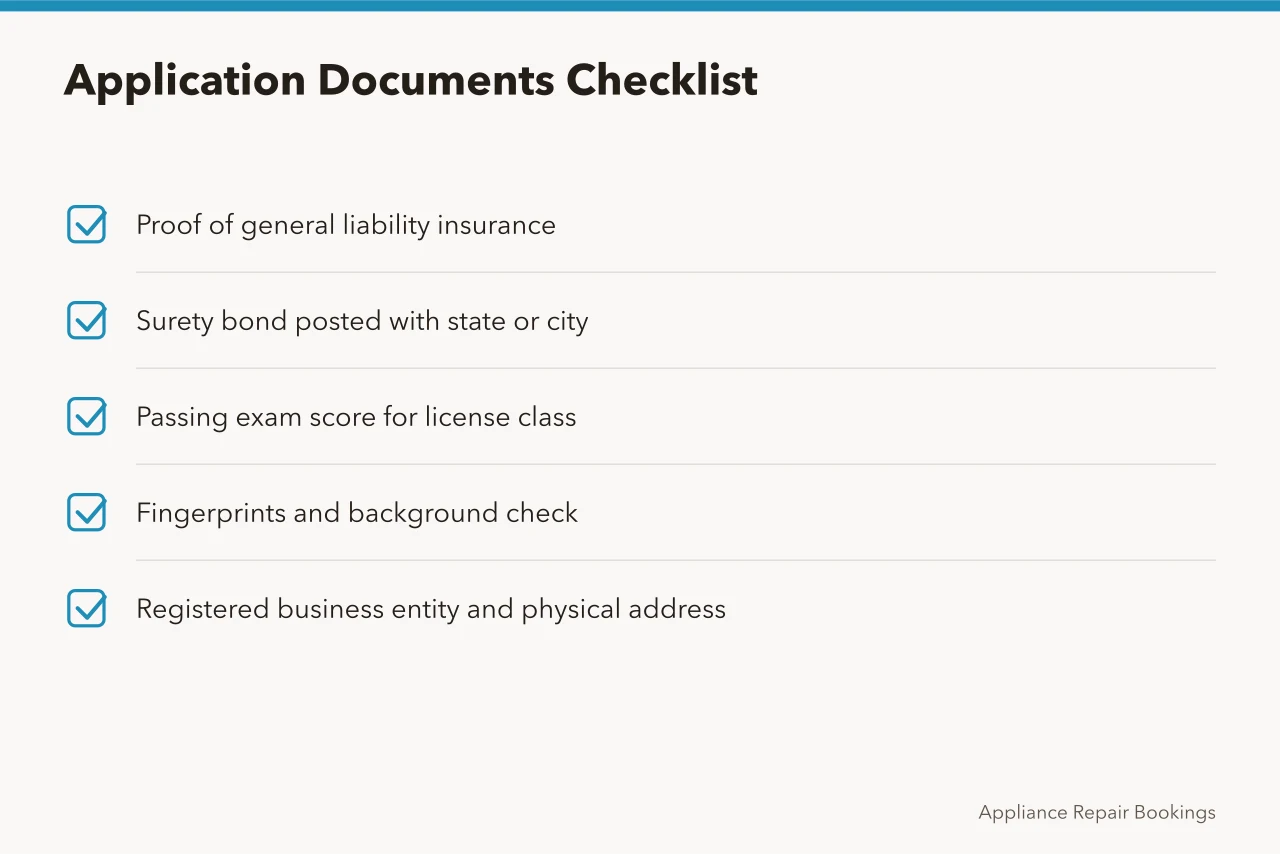
Boards differ on forms, but the same five items turn up again and again.
- Proof of general liability insurance, usually at the state minimum plus the customer's contract requirement.
- A surety bond, posted with the state or the city, in the amount the licensing board sets.
- A passing exam score for the specific license class, such as electrical or refrigeration.
- Fingerprints and a background check for licenses that involve entering occupied homes.
- A registered business entity and a physical address in the licensing state.
EPA Section 608 sits outside this file. You sit a proctored exam, and the programs on EPA's list are approved to provide the Section 608 technician certification test. The certificate carries no state number, so it travels with you across state lines.
How long approval takes
State contractor license applications typically run four to eight weeks after a complete file, though boards that are backlogged can take longer. Local permits for a single electrical or gas job are usually issued the same day or within a few business days.
EPA 608 results come back immediately after the exam.
Approval Timelines
- State contractor license4-8 weeks after complete file
- Local permit for single jobSame day to few business days
- EPA 608 exam resultsImmediately after exam
Plan your first jobs around the slowest approval, not the fastest. A shop that books sealed system work before the certification card arrives is booking work it cannot legally finish.
If your state is not one of the five
Other states, including Florida and New York, leave appliance repair largely unlicensed at the state level and let cities decide. New York City requires an Electronic and Appliance Repair license from the Department of Consumer and Worker Protection. That is a city rule, not a state one.
The job decides the gatekeeper. Gas work brings in a state plumbing or gas license and a local inspector, and fixed wiring brings in an electrical permit. Build that check into your repair workflow before booking.
Work Triggers and Oversight
Work performed
- Control board or door switch
- None beyond registration
- Sealed system recharge
- EPA Section 608
- New 240V circuit
- State electrical license
- Gas line to range
- State plumbing or gas license
- Warranty repair
- Manufacturer authorization
Typical oversight
- Control board or door switch
- Nobody
- Sealed system recharge
- EPA via certified techs
- New 240V circuit
- City or county inspector
- Gas line to range
- Local inspector
- Warranty repair
- Manufacturer audit
Who checks
- Control board or door switch
- Sealed system recharge
- New 240V circuit
- Gas line to range
- Warranty repair
A shop that only swaps parts and never touches a sealed system or a gas line may need no state license at all. That is a business decision, and it belongs in the plan behind an appliance repair business before you take the first call.
What skipping it costs
In California, contracting without a required license is a misdemeanor under Business and Professions Code section 7028, and the Contractors State License Board can seek criminal penalties and a civil citation.
A fine is one cost. Unlicensed work can void the manufacturer's warranty on the appliance, which shifts the cost of a failed compressor back to you. It can also void the homeowner's insurance coverage if a fire is traced to the connection you made.
OSHA treats the electrical side seriously as well. The agency's electrical safety requirements apply to any technician working on energized equipment, licensed or not.
Common questions
Is there a national appliance repair certification?
No. The EPA Section 608 credential is federal but narrow, covering refrigerant handling. Manufacturers run their own authorization programs, and those are private contracts, not licenses. For warranty-side jobs, see home warranty repair work.
Which states actually license appliance repair?
Five states have active programs: California, Texas, Louisiana, Virginia, and Michigan. Most states license nobody for part-swapping work.
Does an out-of-state license transfer?
Rarely at full value. Most boards require you to apply in-state, and some offer reciprocity only for specific license classes. Check the board's own reciprocity page rather than a third-party summary.
What if I work in a state with no license?
You still need a business registration, insurance, and any local permit for electrical or gas work. Skipping those leaves you exposed on liability even where the state is silent.