Guides
How to build an appliance repair company from scratch
'how to start appliance repair business' connects customer access, operating capacity, staffing, and cash. This guide treats the topic as a series of decisions that.
What to take away
- To build an appliance repair company from scratch, start with territory, legal structure, price list, tool kit, booking tools, and the first hire.
- Register an LLC with your state; filing fees typically run $50 to $500, and an EIN from the IRS is free.
- Charge a diagnostic fee of $75 to $125 and labor of $95 to $175 an hour.
- Confirm your state contractor license, liability insurance, and EPA Section 608 certification before any sealed-system job.
- Book work through a Google Business Profile plus Jobber or Housecall Pro, and track drive minutes per completed job from week one.
This article provides general business information, not legal, tax, electrical, gas, or refrigerant advice. Appliance repair licensing and technical requirements vary by jurisdiction and type of work, so confirm the rules that apply before offering a service.
Starting an appliance repair company comes down to a short list of decisions: where you drive, who answers the phone, what you charge, what gear you own, and who keeps the books. Each one has a public record you can check before you spend money. The fee, license, and wage examples below are United States ones.
Typically $8,000 to $25,000 to launch if you already own a van, plus $15,000 to $35,000 for a used cargo van.
How to build the business, step by step
Step 1: Territory, legal structure, license, and gear
Pick a compact service area, roughly a 10 to 15 mile radius around a dense suburb, so one technician can complete four to six calls a day. Wide maps starve the schedule before density arrives.
Form an LLC with your state's secretary of state. Filing fees typically run $50 to $500. California charges $70 up front plus an $800 annual minimum franchise tax, Texas charges $300, and New York charges $200 plus a county publication requirement. Then get a free EIN from the IRS and open a business bank account.
Controlled Launch Sequence
- Open limited schedule
- Test intake
- Test routing
- Test diagnosis
- Test quotes
- Test authorization
- Test parts ordering
- Test payment
Check your state licensing board before you advertise. The California Contractors State License Board, the Texas Department of Licensing and Regulation, and the Florida Department of Business and Professional Regulation all publish searchable license records.
Gas appliance work and sealed refrigeration systems carry separate rules. EPA Section 608 certification is required for anyone who handles refrigerant, and the exam typically costs $25 to $150 through a testing provider.
Carry general liability insurance, typically $400 to $1,200 a year for a small service operation, plus commercial auto coverage and a tools floater. Some states require a surety bond, often $10,000, which typically costs $100 to $300 a year.
A starter tool kit runs about $1,500 to $4,000. Expect a true-RMS multimeter such as the Fluke 117 (about $200), a clamp meter, and a refrigerant manifold gauge set. Add a vacuum pump, a leak detector, hand tools, and a tablet for photos and signatures.
A used cargo van typically costs $15,000 to $35,000, and lettering or a wrap adds $1,500 to $4,000. Some operators lease instead and keep the cash for leads.
Step 2: Intake, booking tools, and parts
Capture the address, appliance type, brand, model, and symptom on every booking. Add the error code, access notes, warranty status, and the customer's availability window.
Intake Data To Capture
- Address
- Appliance type
- Brand
- Model
- Symptom
- Error code
- Access notes
- Warranty status
Jobber's entry plan typically runs about $29 to $49 a month per user, and Housecall Pro typically runs $79 to $189 a month. ServiceTitan quotes per technician and usually fits crews of five or more.
Open parts accounts with Parts Town, Marcone, Reliable Parts, and AppliancePartsPros.com before the first call. Parts Town and Marcone publish factory service manuals and tech sheets. Keep a $500 to $1,500 parts float.
Give intake a named owner and keep a written record of who booked what. The practical risk is sending a technician out with only a name and a vague symptom.
Step 3: Prices and a controlled launch
Price the diagnostic visit at $75 to $125 and labor at $95 to $175 an hour, with parts marked up 40% to 100% over cost. A typical repair ticket lands between $200 and $400. Take payment on site through Square (2.6% plus 10 cents in person) or Stripe (2.9% plus 30 cents online).
Open a limited schedule and test intake, routing, diagnosis, quotes, and authorization before adding volume. Then test parts ordering, payment, warranty wording, and follow-up. Run the test in an ordinary week and again under pressure.
Give one person authority to maintain the process and to make exceptions visible. Use callbacks during launch to start a conversation, not to score a technician.
Claim a Google Business Profile and set a service radius before buying ads. Local Services Ads bill per lead, typically $15 to $50 for appliance repair, and Angi, Thumbtack, and Yelp sell leads on the same model.
Manufacturer networks run by Whirlpool, GE Appliances, Samsung, and LG require proof of insurance, background checks, and technician certification. In return they send warranty work and often supply parts at lower cost.
Step 4: Hiring or subcontracting the first technician
The first technician is either a W-2 employee or a 1099 subcontractor, and your state's classification rules decide which label fits. The IRS looks at who controls the schedule, the tools, and the work.
An employee means payroll taxes, workers' compensation, and usually a van, tools, and a phone on your books. A subcontractor typically brings those and bills per completed job at a higher rate.
Set the wage from the BLS median for home appliance repairers in your metro, and expect to beat what a dealer service department offers. Screen for EPA Section 608 certification before anyone touches a sealed system.
Do not add a second technician until drive minutes per completed job and callback rate hold steady for a month.
Agencies and numbers to confirm before you start
The U.S. Small Business Administration: SBA Business Guide covers planning, launch, management, and growth, including market research, permits, and finance. SBA 7(a) loans top out at $5 million, and microloans through SBA lenders cap at $50,000.
The Internal Revenue Service: Starting a business page covers structure, tax IDs, and recordkeeping. An EIN is free, an S corporation election uses Form 2553, and a single-member LLC files Schedule C by default.
The U.S. Bureau of Labor Statistics: Home Appliance Repairers page lists employment and wage estimates by state and metro area. Its May 2023 figures put median annual pay for home appliance repairers in the $45,000 to $50,000 range, so check your metro before setting a starting wage.
The first 90-day review
Review drive minutes per completed job, callback rate, average ticket, and receivables at 30, 60, and 90 days. A missing number tells you what to research next.
How it plays out for one operator
Suppose an appliance repair business opens with diagnostic meters, one experienced pair of hands, and a few homeowners with a failed appliance. The first service call goes well; the second runs long, which is normal.
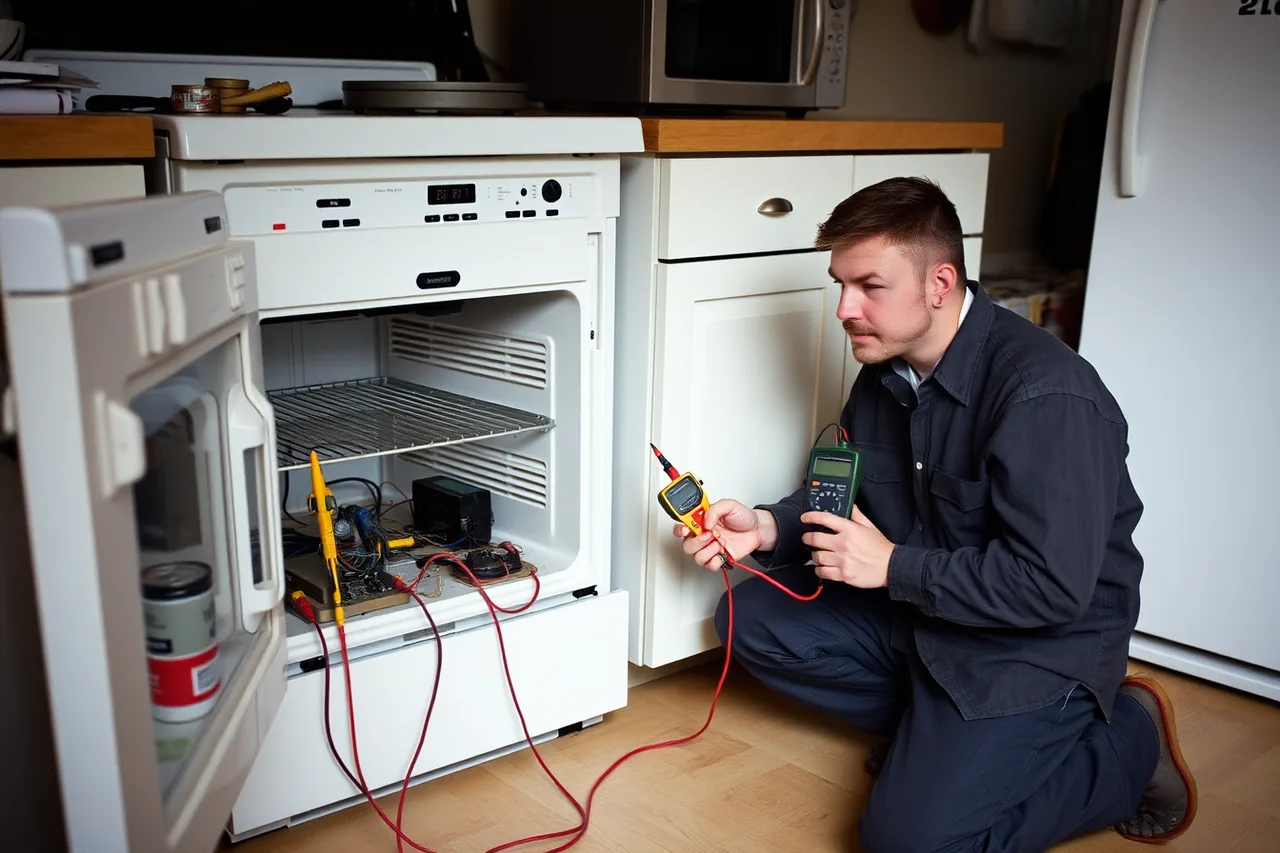
A part ordered for a job that is then cancelled is the thing to plan for. The operator takes a deposit on parts over $150 and checks stock with Marcone before promising a date.
By summer, refrigeration failures leave the calendar fuller than the equipment. The question is whether to add parts inventory or turn work away.
Operators who do well here priced each service call to survive the long ones. They kept state contractor licensing office paperwork current from the first week. They asked every satisfied homeowner for the next referral.
Common questions
What should the service area cover at launch?
A 10 to 15 mile radius around a dense suburb is enough for four to six calls a day. A wider map drives up minutes per completed job.
What should intake capture before advertising?
The address, appliance type, brand, model, and symptom. Also the error code, access notes, warranty status, and availability window. A technician who arrives with only a name and a vague symptom wastes the visit.
Where does a controlled launch usually fail?
Testing on the first fully booked week. Open a limited schedule and test intake, routing, diagnosis, quotes, and authorization first, then parts ordering, payment, warranty wording, and follow-up.
What does it cost to start?
Typically $8,000 to $25,000 if you already own a van, covering tools, insurance, licensing, and the first month of leads. A used cargo van adds $15,000 to $35,000, and lead costs run from there.